 The Moderator of the General Assembly of the Evangelical Presbyterian Church, Ghana (EPCG), Rt. Rev. Dr. Lt Col Bliss Divine Kofi Agbeko (Rtd), has presented a comprehensive account of his six-year tenure, highlighting progress in evangelisation, youth ministry, digital transformation, financial management, institutional development and the preservation of Church properties.
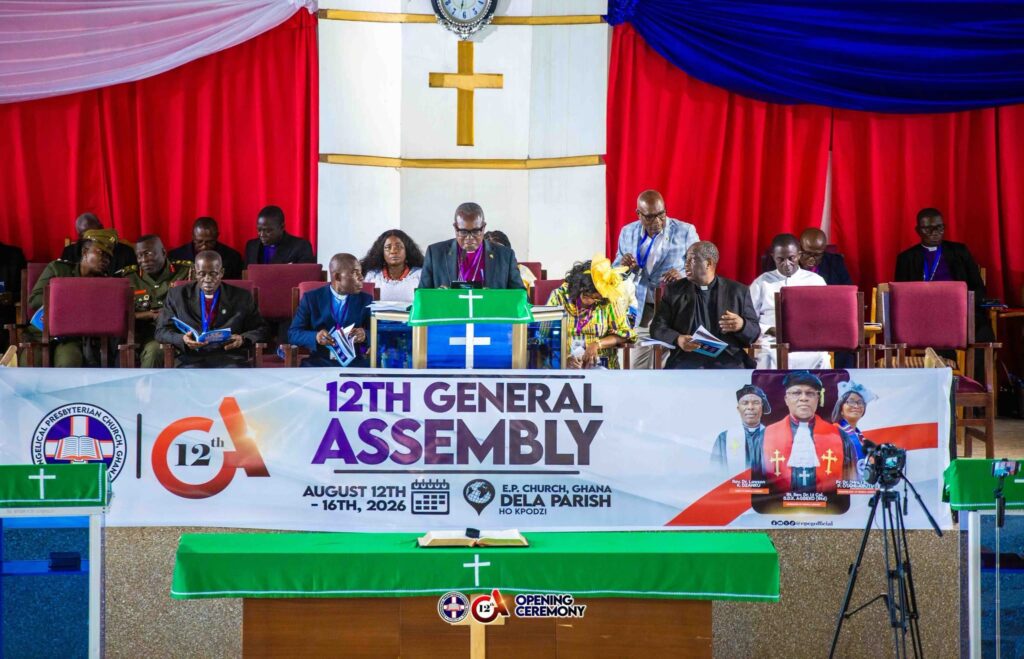
Delivering his final Moderatorial Address at the 12th General Assembly in Ho, the Moderator expressed gratitude to God for sustaining the Church and described his administration as a collective journey undertaken with ministers, presbyters, officers and members of the EPCG. He said the gathering provided an opportunity to reflect on the aspirations, commitments, challenges and achievements of the administration.
Emphasis on Christian discipline and ethical leadership;
Rt. Rev. Dr. Agbeko said his administration had placed strong emphasis on Christian spirituality, love, discipline, holiness and ethical conduct in keeping with the Reformed Presbyterian heritage of the Church.
He acknowledged that the administration had been compelled to take disciplinary measures against some agents over issues including disregard for constituted authority, unauthorised disposal of Church property, failure to account for resources and moral misconduct. He stressed that such measures were taken in the interest of protecting the unity, discipline and integrity of the Church.
He consequently charged his successor to maintain high standards of discipline, holiness and ethical conduct without fear or favour, while ensuring that all actions were undertaken in love and faithfulness to Christ.
Evangelisation and a more inclusive Church;
The Moderator reported significant progress in the Church’s national evangelisation agenda, particularly the effort to establish and nurture multi-ethnic and inclusive congregations.
He noted that although the EPCG had historically flourished largely among the Ewe people because of its missionary beginnings, the Church had now expanded to every political and administrative region of Ghana, with additional Presbyteries in Europe and North America.
According to him, the increasing use of indigenous languages other than Ewe in worship, together with ongoing work on Twi and Konkomba hymnals, reflected the Church’s commitment to becoming more inclusive and responsive to the communities it serves. He also highlighted evangelistic missions and crusades organised across several Presbyteries.
Youth ministry and postmodern worship;
Rt. Rev. Dr. Agbeko said the Church must continually reform aspects of its ministry to respond to changing social realities while remaining firmly rooted in its theological and Presbyterian traditions.
He said his call for a new level of postmodern ministry was primarily intended to create meaningful space for young people within the Church. He cited the emergence of several experiential worship programmes across congregations as evidence of growing youth participation.
The Moderator urged the Church to give particular attention to the Youth Resource Centre under construction at the Headquarters, describing it as an important component of the Church’s efforts to strengthen youth development and engagement.
Digital ministry and technology;
The Moderator also reported progress in the Church’s adoption of modern technology as a tool for evangelisation, administration and Christian fellowship.
He disclosed that the EPCG had successfully organised an emergency General Assembly online for the election of a Council Chair of the Evangelical Presbyterian University College, while every two of the four mandated annual sessions of the General Assembly Executive Council had been held virtually for the previous three years.
He further announced that the Church had secured and registered a radio frequency under the name Bremen Radio, describing the initiative as an opportunity to educate communities and extend the Church’s witness. He commended Dela TV for its contribution to the Church’s online ministry.
At the same time, he cautioned against the risks associated with the digital environment, including misinformation, unauthorised use of the Church’s identity, cybersecurity threats, copyright violations, financial fraud and online impersonation.
He disclosed that an Online Worship, Digital Communications and Social Media Policy was being developed to regulate digital activities undertaken in the name of or on behalf of the EPCG and to safeguard the Church’s doctrine, identity, unity and reputation.
Financial liberation and investment
A major component of the address was the Moderator’s call for the Church to pursue greater financial independence through viable and ethical investments rather than relying predominantly on voluntary offerings.
He said the EPCG had over the years undertaken ventures in agriculture, hospitality, education, publishing and health, but acknowledged that several had not produced the expected results.
As part of efforts to develop sustainable alternative revenue streams, the administration established the Prime Natural Mineral Drinking Water Company at Tsito, known commercially as Prima Water. According to the address, the business recorded a 22.88 per cent increase in revenue between 2024 and 2025, increased gross profit, reduced administrative expenses and an 84.39 per cent reduction in net losses.
The Moderator emphasised that the investment belonged to the Church and urged members to support and protect all Church commercial ventures so they could contribute meaningfully to the financial sustainability of the EPCG.
Membership database and generational ministry
The Moderator reported progress towards the establishment of a comprehensive national membership database containing information on members’ locations, occupations, skills and capabilities.
He said a national census had been conducted, although participation was uneven across congregations. He maintained that the database had already demonstrated its usefulness for planning, communication and outreach and urged the Church to support its further development.
He also highlighted efforts to bridge the generational gap within the Church, particularly through a generational group concept being piloted in the Ho-East Presbytery. The model provides a progressive pathway from Children’s Ministry through Junior Youth, Youth and Young Adults Fellowship.
The initiative, he said, had been incorporated into the Church’s five-year Strategic Plan as a key performance indicator and included in the reviewed Youth Policy currently under consideration.
Protection of Church properties
On property management, Rt. Rev. Dr. Agbeko said the administration had commenced efforts to retrieve, secure and properly document Church properties.
He disclosed that Legal and Landed Property Committees had been established across the Presbyteries to coordinate property documentation and safeguard Church assets. He noted that the Church continued to face challenges including land encroachment, inadequate documentation, poor maintenance, unauthorised occupation, boundary disputes and litigation.
Church debt reduced by GHS5.7 million
One of the most significant achievements highlighted in the address was the reduction of the Church’s debt burden.
The Moderator said the EPCG inherited a debt exposure of approximately GHS8.9 million, comprising an opening balance of GHS7.1 million as of December 2020 and additional obligations of about GHS1.7 million.
He reported that the Church had subsequently paid GHS5.7 million, representing approximately 64.4 per cent of the total debt, leaving an outstanding balance concentrated mainly in the National Investment Bank (NIB) and CEVAA. The address put the remaining NIB obligation at approximately GHS2.9 million and the CEVAA balance at about GHS254,000.
The detailed debt schedule presented in the address showed a total debt portfolio of GHS8,901,171.35, of which GHS5,729,406.79 had been paid as of June 23, 2026, leaving an outstanding balance of GHS3,171,764.56.
The Moderator urged that, going forward, departments and institutions of the Church should obtain approval from the General Assembly Executive Council before contracting loans, while delays in servicing existing obligations should be reported to the Council.
175th Anniversary legacy projects
The Moderator also reflected on the EPCG’s 175th Anniversary celebrations, which he said were successfully organised despite the absence of an established plan or budget when he assumed office.
The celebrations included a national launch at the Accra International Conference Centre, a grand durbar at Peki Blengo and a national thanksgiving service at Ho Jubilee Park. The anniversary also gave rise to the Youth Resource Centre as a legacy project.
He further reported that the first phase of the 175th Anniversary Conference Centre, involving foundational and ground works valued at approximately GHS1 million, had been completed, with further phases awaiting funding.
Calls for constitutional and institutional reforms
The Moderator called for a comprehensive review of the EPCG Constitution to address emerging governance and administrative challenges.
Among the areas he identified for review were the tenure of certain office bearers, nomination processes for Standing Committee elections, appointments and employment considerations. He also called for constitutional provisions addressing the intentional and destructive use of social media and artificial intelligence against Church agents and members.
He further proposed reforms in ministerial training, chapel design and construction, social media governance, and the broader formation of ministers and agents to respond effectively to changing social and theological realities.
Looking ahead
As the 12th General Assembly commenced its deliberations, the Moderator identified key areas on the agenda, including receiving reports, consideration of the Church’s finances, constitutional matters, policy formulation, disciplinary matters, and the election of a new Moderator.
In his closing appeal, Rt. Rev. Dr. Agbeko urged delegates to approach the Assembly with unity, truth, love and prayer. He encouraged members to debate issues without division, make decisions without unnecessary delay and leave the Assembly without bitterness.
He noted that the 12th General Assembly marked the completion of his tenure as Moderator after six eventful and challenging years and expressed appreciation to his family, colleagues, Church members, supporters, the Ghana Armed Forces and the President of Ghana for their support during his tenure.
“Let us debate without fighting or division, decide without delay and depart without bitterness,” he urged, calling on delegates to remember that they were custodians of the Church and stewards of the Gospel entrusted to them.
The address concluded with the formal declaration of the 12th General Assembly duly opened in the name of God the Father, the Son and the Holy Spirit, marking the beginning of the Assembly’s deliberations and the transition towards a new phase of leadership for the Evangelical Presbyterian Church, Ghana.